Our proprietary dating app success testing and scoring system is at the heart of our reviews and recommendations. Our metric ranks a person’s likelihood of a successful outcome when using a dating app or dating site.
By standardizing our testing and requirements, we provide an unbiased and repeatable way to rank and review dating apps for different groups.
Our testing scores allow you to quickly identify which dating app is best for you.
In the next few sections, we’ll share our overall rating algorithm and break down how we calculate a score in each category.
Overall Scoring Factors
Our overall score is composed of eight individually tested and calculated scoring factors that are combined through the use of weighted averages to determine our final rating.
Here is the overall breakdown.
| Factor | Weighted Average |
|---|---|
| Safety and Security | 20% |
| Profile Engagement | 15% |
| Feature Effectiveness | 15% |
| Pricing | 15% |
| UX and Usability | 10% |
| Popularity | 10% |
| External Reviews | 10% |
| Feature Growth | 5% |
Within each factor, individualized testing is conducted to determine an overall score on a scale of 1 to 10. Non-whole number scores are rounded to the second decimal place. Once each individual factor’s testing is completed, the final numbers are combined based on the weighted average shown above. At this point, non-whole number scores are again rounded to the second decimal place.
Exogenous Factors
In addition to our standardized scoring system, intangibles, soft factors, and any other exogenous factors may be weighed into the equation. When this is done in a dating app review, our review team will share the factors that were included and how they affected the final outcome.
Proprietary Score Factor Methodology
For transparency of research, we’ll not walk you through each of the eight factors we test and evaluate during our dating app review process.
Safety and Security (20%)
The most important factor in our scoring and testing process is safety and security, reflected in the highest weighted average at one-fifth of the overall total score. To calculate, our team puts each dating app through our 9-point safety and security checklist.
| Factor | Scoring System | Weight |
|---|---|---|
| Privacy Policy Protections | Scored 0-10 | 15% |
| Third-Party Data Usage | Scored 0-10 | 15% |
| App and Data Encryption | Scored 0-10 | 15% |
| Block and Report Options | Scored 0-10 | 15% |
| Account Verification Options | Scored 0-10 | 10% |
| Data Minimization Practices | Scored 0-10 | 10% |
| 2FA Available | Scored 0-10 | 10% |
| TOS Acknowledges Safety | Scored 0-10 | 5% |
| Strong Password Requirements | Scored 0-10 | 5% |
- Testing factors marked ‘0-10’ earn a quality or effectiveness score based on the level of quality or effectiveness.
The list of data points within each factor of the 9-point safety and security checklist are based around, but not limited to the following factors:
- Privacy Policy Protections – Is the dating app’s privacy policy clear about how your data is collected, stored, shared, and deleted? Does it detail how the data is used and are all of these expected uses for a user? If required, is the dating app GDPR or CCPA compliant?
- Third-Party Data Usage – How is the dating app using your data in relation to third parties? Is it being shared? If so, what are the uses for this sharing, and are they clearly explained?
- App and Data Encryption – Is your data safe and protected through industry-standard means? These include, but are not limited to SSL Encryption, E2EE message encryption, encrypted data storage (at rest), content security policy, CAPTCHA for signups and login attempts, and secure backend infrastructure.
- Block and Report Options – Is it easy to block and report users you no longer wish to interact with? How serious does the app take reports of things like scammers, bots, and bullies?
- Account Verification Options – Does the app have options for verifying accounts and photos? If yes, is it required in any capacity? How effective is it?
- Data Minimization Process – Is the dating app or dating site only collecting necessary information to service the user? Is additional, unnecessary data being collected?
- 2FA Available – Does the dating app or site give users the option to use two-factor authentication?
- TOS Acknowledges Safety – Is safety addressed in the Terms of Service? If so, how is it addressed?
Profile Engagement (15%)
Testing how engaged a dating app’s userbase is can be challenging to approach from an ethical angle. Sending messages to users solely as a test is not something we are comfortable doing. While we are limited, there are several factors we can assess to help determine how engaged the userbase is including:
| Factor | Consideration |
|---|---|
| Profile Completeness | % of profile fields completed per user |
| Number of Photos Uploaded | Tested as a % of available slots utilized |
| Last Active Times | When available, tested to see activeness of database |
| Secondary Resources | How active users are on secondary resources (forums, communities, etc.) |
| Available Metrics | When available, interactivity and success metrics provided by the company |
Feature Effectiveness (15%)
This testing metric focuses on two main things, the overall effectiveness of features and technically how well the features work. Here is the weighted breakdown of how we value these features during testing to limit subjectiveness as much as possible.
| Factor | Weight | Description |
|---|---|---|
| Primary Matchmaking Feature | 40% | Effectiveness and quality of the main matchmaking feature |
| Secondary Matchmaking Feature(s) | 20% | Effectiveness and quality of any secondary matchmaking features |
| Additional Support Resources | 20% | Any additional resources designed to support the matchmaking process |
| Technical Consideations | 20% | Deep technical analysis of reliability and infrastructure of features |
Pricing (15%)
Evaluating pricing requires deeper analysis beyond just the absolute price charge for a subscription. Understanding that the more effective data point is how price relates to value, some subjective input is needed when determining outcomes here. Additionally, many dating apps and dating sites may seek to serve different demographics that may be more or less price sensitive.
To remove as much subjectiveness as possible, our team has developed a proprietary metric known as Dating App Value Per Dollar (DAVPD). Our DAVPD metric allows us to compare dating apps from all price ranges on a level playing field.
To calculate DAVPD, our team has create a value range for 29 of the most common dating app features or factors with a total number of points of 2,000.
- If the feature does not exist, the score is 0.
- If the feature exists, the maximum score is anywhere from 10 to 500, based on how important the feature is.
- Based on the quality of the feature, it receives a score between 1 and the maximum possible.
- It is understood that there may be crossover of tested features with other parts of the algorithm.
Each dating app is evaluated on all 29 features. The total score is added up and divided by the monthly cost of the dating app. The resulting number is the DAVPD for the app.
For example, let’s say a dating app scores 1,700 points. If the cost of the app were $30 per month, then 1,700 points divided by $30 equals a DAVPD of 56.67. If an app had the same quality but was only $20, the DAVPD would be 1,700 points divided by $20, which equals a DAVPD of 85.00. As you can see, the second option would be a higher value indicating a better price value.
Here are the criteria and total maximum number of points available for DAVPD testing.
| Feature/Factor | Maximum Points |
|---|---|
| Matchmaking Process | 500 |
| Curated Matchmaking | 250 |
| Size of Membership | 150 |
| No Excessive Gamification | 100 |
| U.S. Based Company | 100 |
| End to End Encryption | 75 |
| SSL Encryption | 75 |
| Robust Profiles | 50 |
| App Store Rating | 50 |
| Google Play Store Rating | 50 |
| Report and Block | 50 |
| Profile Verification Optional | 50 |
| Profile Verification Required | 50 |
| Additional Resources | 50 |
| Refund Policy | 50 |
| Email Verification | 50 |
| SMS Verification | 40 |
| Email Support | 40 |
| Video Profiles | 30 |
| Religious Filters | 20 |
| Smoking/Drinking Filters | 20 |
| Profile Completion Requirement | 20 |
| Phone Support | 20 |
| Video Chats | 20 |
| Account Pause Feature | 20 |
| Last Active Feature | 20 |
| 2FA Protection | 20 |
| Photo Options | 20 |
| Community Forums | 10 |
Important Note – DAVPD must be weighed in their raw format as well as against your individual price sensitivity, which our team subjectively does attempt to do within reviews and ranking lists. Please read the example below.
If dating app A scores 1,800 points and costs $30, and dating app B only scores 1,500 points but costs $20, the DAVPD numbers would reflect 60.0 for app A and 75.0 for app B. If you only compared these apps on the DAVPD figure, you’d assume that app B is the better value. Technically, you’d be correct. However, the price difference of $10 a month may be a number that is worth it to you to pay for an app that is 20% better (1,500 to 1,800 raw points).
The DAVPD figure becomes more important the larger the price difference or the greater the price sensitivity of the user.
UX and Usability (10%)
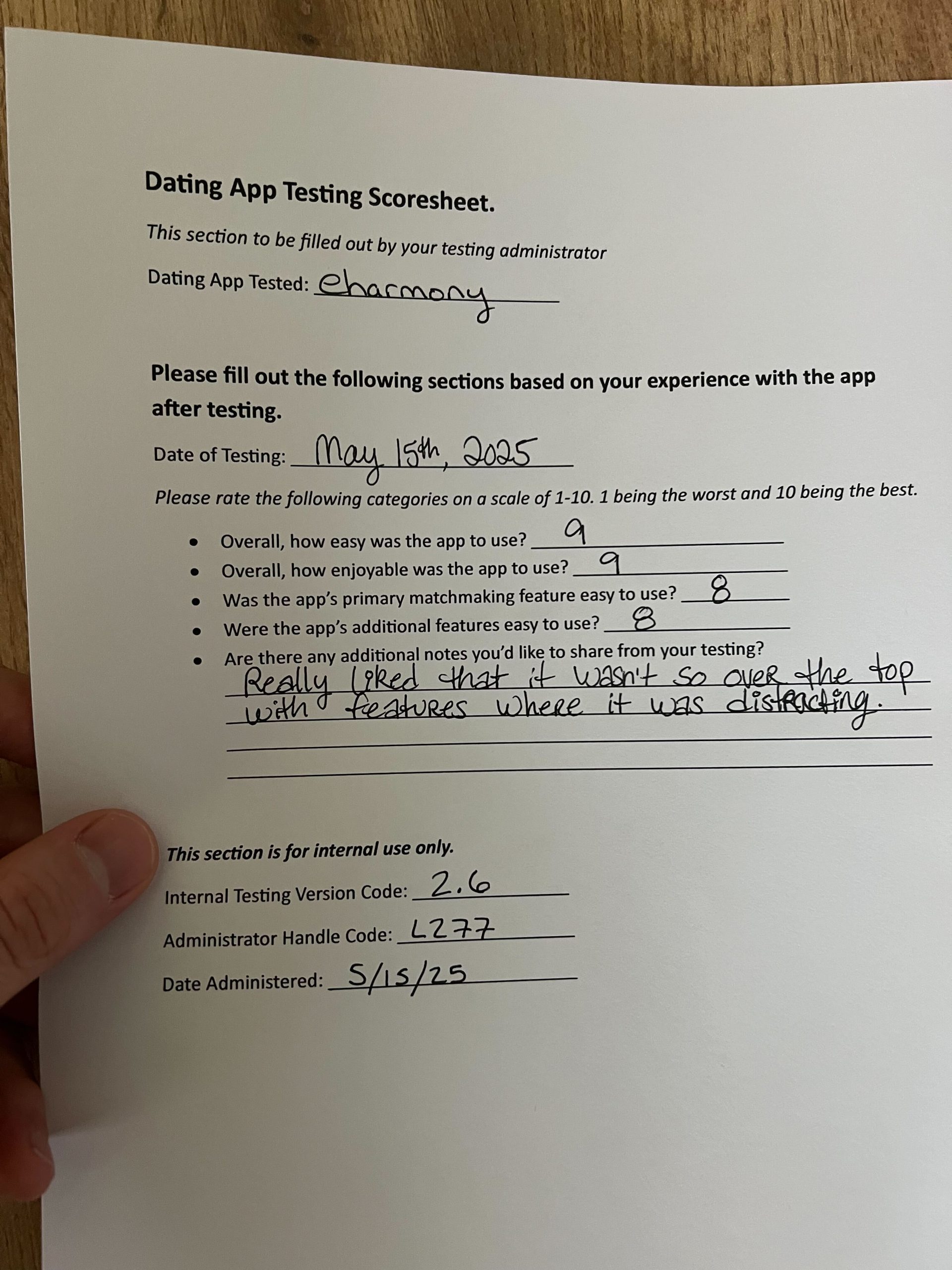
For each dating app we test, our team employs a focus group of internal and external testers to rate the user experience (UX) and usability of the app. Focus group participants are asked to rate the app based on 4 categories with a rating between 1 and 10 and 1 section for additional notes.
Here are the five categories/sections and a picture of one of our in-person UX and usability testing scorecards.
- Overall ease of use
- Overall enjoyability
- Rating of app’s primary matchmaking functionality
- Rating of app’s secondary matchmaking functionality
- Additional notes from testing
Popularity (10%)
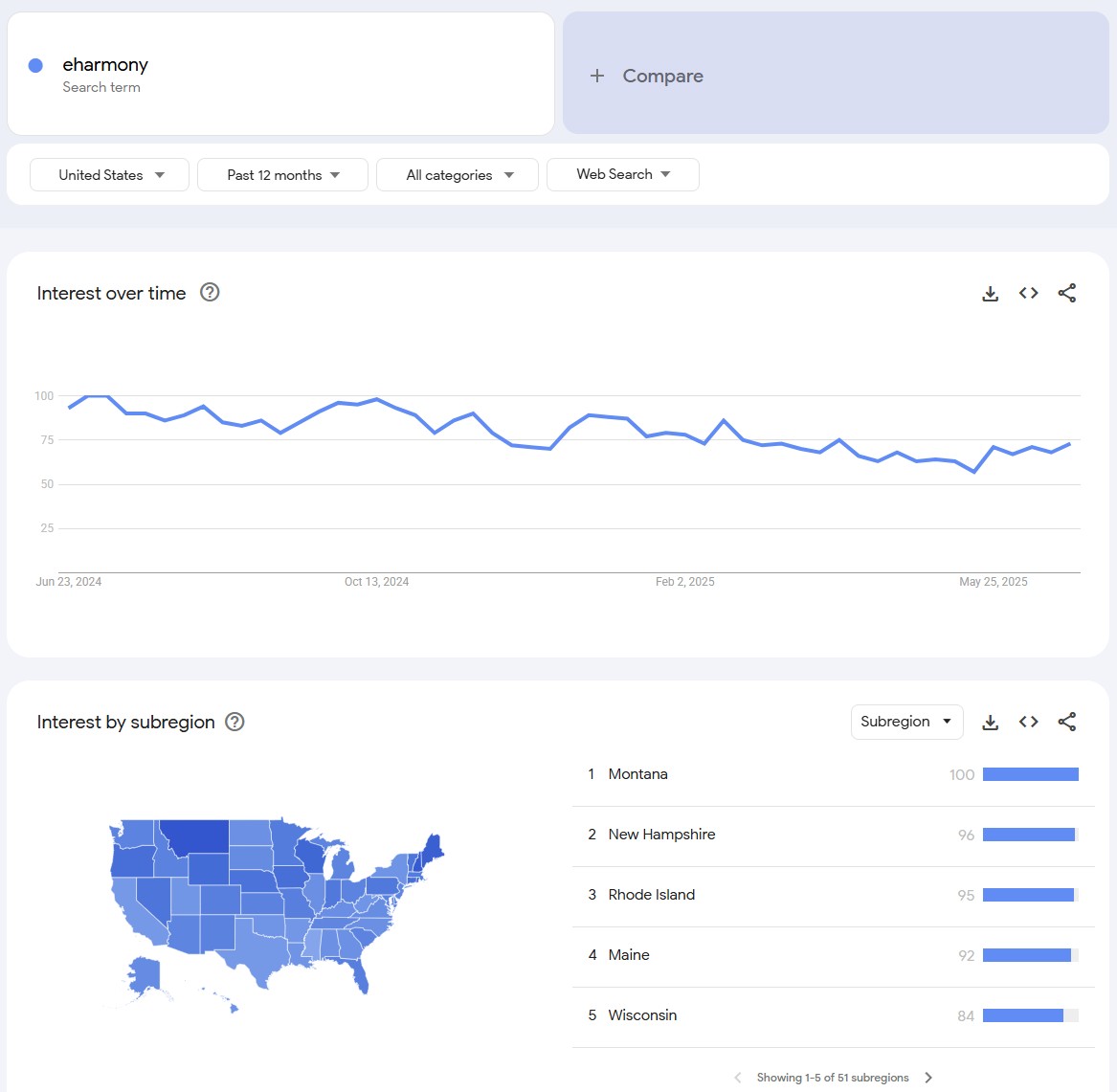
Determining a dating app’s popularity is an important test to gauge relevance and membership size, especially when membership numbers aren’t made publicly available.
Our proprietary algorithm uses data points from the following sources:
- Search Trends – Search volume trends tools (Google Trends)
- Internal Testing – Internal questionnaire studies and testing
- Search Volume – Search volume estimation tools (Ahrefs, MOZ, Semrush, etc.)
- Traffic – Traffic statistics (SimilarWeb)
- News Coverage – News coverage volume (with adjustments for one-time stories)
- Social Reach – Social reach metrics and trends
| Factor | Weight |
|---|---|
| Search Trends | 25% |
| Internal Testing | 25% |
| Search Volume | 15% |
| Traffic | 15% |
| News Coverage | 10% |
| Social Reach | 10% |
External Reviews (10%)
While the majority of our proprietary dating app testing system is based off of internal metrics, we acknowledge that outside review aggregators may be worth review as part of a complete process. These help our team identify trends, gauge a wider audience of feedback, and see adoptability rates of new features and changes.
Here is a list of external review aggregators we may use:
- App Store Reviews
- Google Play Store Reviews
- Google Business Listing Reviews
- Trust Pilot
- Consumer Affairs
- Better Business Bureau
Our team understands the volatile nature of online reviews and that reviews may be false, some providers allow purchase to remove negative reviews, and that users typically only report polarized experiences (overly positive or overly negative). This is weighed in our decision when choosing which data points to employ.
Feature Growth (5%)
Specifically for dating apps supported by Apple and Android, our team monitors and analyzes the frequency and breadth of updates to the platform.
| Factor | Testing Description |
|---|---|
| Total Number of Updates | How many updates in total |
| Frequency of Updates | Cadence at which updates are pushed |
| Last Update | Length of time since the last update |
| Depth of Updates | Level of depth of updates; captures outlier trends in dev strategy |
| Growth vs. Fix Updates | More weight given to updates that grow features |
| Cross Platform | Update rates and test scoring for both major platforms |
Exogenous Factors Applied After Scoring
At times, there are factors important to the success of a dating app that fall outside of our proprietary testing system. In these situations, manual adjustments may be made to the overall score to better reflect the quality, reliability, and effectiveness of the dating app.
Some examples of these factors include, but are certainly not limited to:
- Outside litigation against the company
- Company events that impact the quality of the experience
- Science supporting or in contrast to the matchmaking process implemented
- Safety concerns not contained in the 9-point safety and security checklist
When adjustments are made based on exogenous factors during a dating app review, readers will be notified as to be best equipped to understand the scoring and make a more informed decision.
Errors and Corrections
We make every accommodation possible to be as accurate as possible with our dating app reviews. That said, our proprietary ranking and testing system is complex, challenging to conduct, and does at times have limitations. The chance for mistakes does exist, but we double and triple check our work to limit these as much as possible.
If you do find an error, please reach out to our team to let us know.